Implementing
The practice of implementing tools for specific learners
|
Reflecting on the Development of an Online Learning Cafe This project was completed in the course Constructivist Strategies for E-Learning (ETEC 530). As I discussed in my other artifact reflection for ETEC 530, this course was one of the most influential courses I took during my MET journey, because of the course's focus on knowledge creation (epistemology) and active, authentic learning. This was the only online research cafe that I developed within MET. Essentially an online research cafe works as a mini informal workshop where learners bring a topic into the cafe, and discuss the topics within the cafes that they sign up for. I created my cafe on Constructivism and Online Learning Feedback. Feedback is an important aspect of learning, but it can be hard to provide in online contexts, particularly elaboration feedback which is intended to help guide and scaffold learning. Click on the link below to view the cafe instructions and guidelines: https://blogs.ubc.ca/etec530constructivismandfeedbackresearchcafe/ 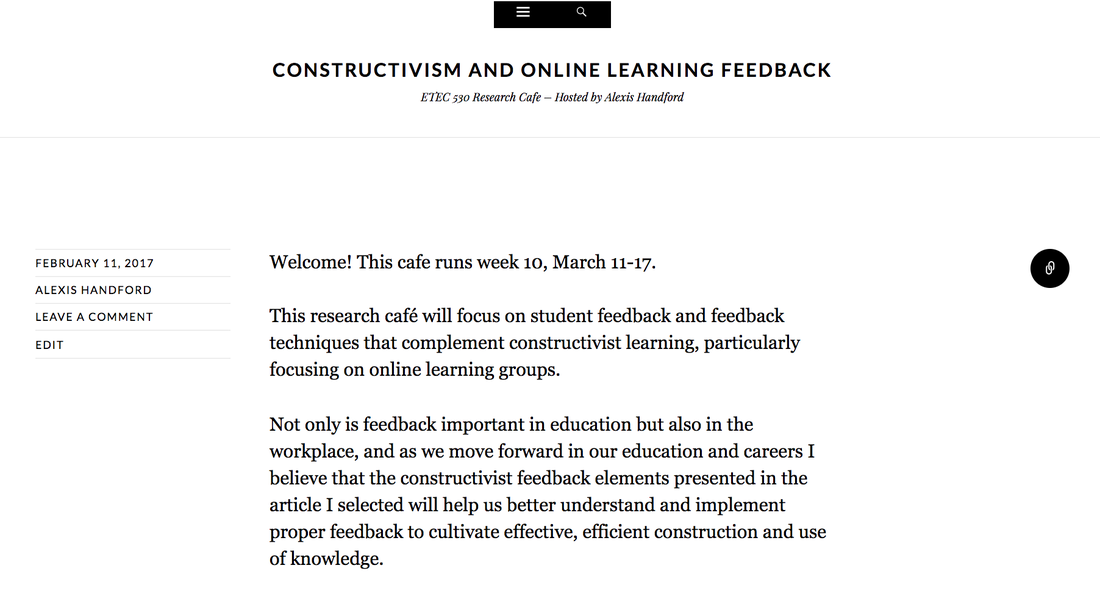 This project was a good activity because it created a brief, yet engaging, learning experience for online learners. Each research cafe was based on a research article - the article I chose to focus on was "Supporting online collaborative learning in small groups: Teacher feedback on learning content, academic task and social participation" by Cesar Coll, Maria Jose Rochera, and Ines de Gispert.
The goal of my cafe was to have my peers read the article, and bring their questions to the discussion board on the topic of implementing feedback into online environments, and also to consider some potential tools that could be useful in implementing feedback into their own practices. This project showed me that instructional designs do not have to be extensive to be successful, a simple online research cafe involving reading an article and responding to questions within a focus group can have a lasting impact on people's understanding as well. This project was appropriate for ETEC 530 and for the focus on constructivist learning, because this research cafe, while guided, allowed learners to guide and scaffold their own understanding, and also to participate in discourse with their peers.
0 Comments
Leave a Reply. |
ImplementingThe practice of implementing tools and strategies for specific users is an important skill of educational technologists. And being mindful of users is an important part of the PCK of TPCK as "PCK is concerned with the representation and formulation of concepts, pedagogical techniques, knowledge of what makes concepts difficult or easy to learn, knowledge of students' prior knowledge, and theories of epistemology" (Mishra & Koehler, 2006, p. 1027). Click here for Page References
Brown, J. S., Collins, A. & Duguid, S. (1989). Situated cognition and the culture of learning. Educational Researcher, 18, 32-42. Cox, K., Franklin, M., Hagen, S., Handford, A., & Mauro, S. (2017). ETEC 500: Research Methodology in Education, research proposal assignment submission [Written PDF document]. Glasersfeld, E. Von. (2005). Introduction: Aspects of constructivism. Constructivism: Theory, perspectives, and practice. (2nd ed.). New York: Teachers’ College Press, 21-25. Glasersfeld, E. Von. (2008). Learning as a Constructive Activity. AntiMatters, 2(3), 33-49. Handford, A. (2017). ETEC 530: Constructivist Strategies for E-Learning, assignment 1 submission [Written PDF document]. John-Steiner, V. & Mahn, H. (1996). Sociocultural approaches to learning and development: A Vygotskian framework, Educational Psychologist, 31, 191-206. Kraemer, E. W., Lombardo, S. V., & Lepkowski, F. J. (2007). The librarian, the machine, or a little of both: A comparative study of three information literacy pedagogies at Oakland University. College & Research Libraries, 68(4), 330-342. Orey, M. (2002). Information Processing. In M. Orey (Ed.), Emerging perspectives on learning, teaching, and technology. Pritchard, D. (2014). What is this thing called knowledge?. Routledge. Wang, Y., Han, X., & Yang, J. (2015). Revisiting the blended learning literature: Using a complex adaptive systems framework. Journal of Educational Technology & Society,18(2), 380-393. Categories
All
Archives |
 RSS Feed
